
If you’ve been in a car accident in Georgia that wasn’t your fault, you’re entitled to compensation beyond just repair costs—diminished value claim Georgia lets you recoup the loss in your vehicle’s market value after damage and repairs. Georgia is one of the most favorable states for these claims, thanks to landmark legal rulings that uphold your right to this recovery. This guide breaks down everything you need to know, from how to calculate diminished value in Georgia to filing a successful claim with the help of insights from the diminished value of Georgia framework.
Georgia Statute of Limitations for Diminished Value Claims
Georgia’s statute of limitations for filing a diminished value claim is four years from the exact date of the car accident. This deadline is governed by the state’s personal injury statute of limitations, which also applies to property damage claims like diminished value. Missing this four-year window will almost certainly result in your claim being denied, with no opportunity to recover lost vehicle value—even if you have overwhelming evidence to support your case.

Understanding Diminished Value After a Car Accident
Diminished value is the permanent reduction in a vehicle’s market value after it’s been damaged in an accident and repaired, even with high-quality fixes. Georgia recognizes three core types, with a focus on accident-related stigma and market comparisons:
- Inherent diminished value: The most common type, it refers to the loss in value solely because the vehicle has an accident history—a stigma that follows even perfectly repaired cars. Buyers and dealerships consistently value accident-free vehicles higher, and this gap is what inherent diminished value compensates for.
- Immediate diminished value: The drop in resale value the moment an accident occurs, before any repairs are made. This reflects the raw damage impact on the vehicle’s worth, regardless of future repair work.
- Market value comparison steps: To calculate this gap, first identify pre-accident market value using trusted sources; then find the post-repair value of identical vehicles with accident history in Georgia’s local market; finally, subtract the post-repair value from the pre-accident value to get the diminished value amount. For accuracy, focus on Georgia-specific listings (e.g., Atlanta, Athens, Savannah) to account for regional market trends.
Key Deadlines: Filing a Diminished Value Claim
- Four-year statute of limitations: As noted, all claims must be filed within four years of the accident date—this is non-negotiable under Georgia law.
- Document preservation deadlines: Preserve all accident and vehicle-related documents immediately (0–30 days post-accident). This includes police reports, repair estimates, pre-accident photos, and valuation records—delays can lead to lost or incomplete evidence.
- Start the process early: Begin filing your diminished value claim Georgia as soon as your vehicle is repaired (typically 1–3 months post-accident). Fresh evidence (e.g., recent appraisals, clear repair records) is far more credible to insurance companies and courts, and early filing leaves ample time for negotiations or appeals before the four-year statute expires.
Preparing Evidence of the Vehicle’s Diminished Market Value
Strong evidence is the foundation of a successful diminished value claim Georgia—insurance companies will challenge weak or incomplete documentation, so gather these critical records:
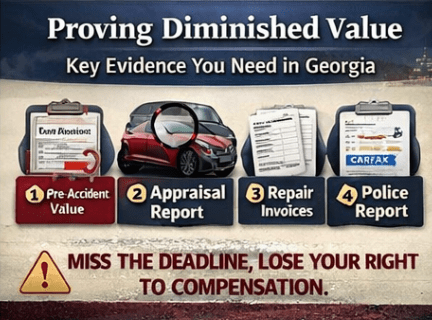
- Pre-accident valuation records: Obtain official valuations from Kelley Blue Book (KBB), NADA, or Edmunds; include local Georgia vehicle listings for identical makes/models; and save any recent appraisals or offers if you were selling the vehicle pre-accident.
- Post-repair appraisal report: Hire a certified diminished value appraiser (licensed in Georgia) to complete a professional post-repair appraisal—this is the most persuasive evidence of lost value.
- Repair invoices and shop photos: Collect all repair estimates, final invoices, and detailed photos (vehicle damage pre-repair, repair process, finished work). Photos should clearly show the extent of damage and the quality of repairs (or lack thereof).
- Carfax and police accident reports: Secure a pre-accident Carfax (or AutoCheck) report proving no prior accident history; obtain the official police accident report to establish fault, damage details, and accident circumstances (critical for third-party claims).
Calculating Diminished Value: Methods and the 17c Formula
How to calculate diminished value in Georgia is a critical step—insurance companies use a formula that undervalues claims, but you have the right to use more accurate methods. Below is a breakdown of the 17c Formula and superior alternatives, aligned with the diminished value of Georgia standards.
Market Value Calculations and 17c Formula
The 17c Formula is an insurance industry-created method widely used in Georgia, but it’s designed to minimize payouts. Here’s how it works, plus its major limitations and better options:

- 17c Formula steps:
- Start with the vehicle’s pre-accident value (KBB/NADA).
- Apply a 10% arbitrary cap (multiply by 0.10)—no basis in real market data.
- Add a damage modifier (0.00–1.00) based on structural damage severity (1.00 = severe structural damage, 0.00 = no structural damage).
- Apply a mileage modifier (0.00–1.00) that penalizes higher-mileage vehicles (0.00 for 100,000+ miles, eliminating all recovery).
- 17c Formula limitations:
- Ignores Georgia’s regional market trends (e.g., higher demand for trucks/SUVs in rural GA vs. sedans in Atlanta).
- The 10% cap is arbitrary and understates loss for luxury/specialty vehicles.
- Redundant mileage modifier (pre-accident value already accounts for mileage).
- Fails to consider non-structural damage (e.g., cosmetic damage to luxury vehicles) that impacts value.
- 17c output vs. independent appraisals: 17c calculations typically yield 30–50% less than independent appraisals, which account for local market data, vehicle type, and real buyer behavior in Georgia.
- Recommendation: Always hire a certified diminished value appraiser (licensed in Georgia) for a professional assessment.
Types of Claims: Inherent, Repair-Related, Immediate Diminished Value
Georgia recognizes three distinct diminished value claims, each with specific documentation requirements:
- Inherent diminished value: Loss in value due to accident history, even with perfect repairs. This is the primary claim for most Georgia drivers, and evidence focuses on market stigma (e.g., Carfax accident history, local market comparisons).
- Repair-related diminished value: Loss in value because repairs failed to restore the vehicle to pre-accident condition (e.g., shoddy body work, mismatched paint, unresolved mechanical issues). This is separate from inherent diminished value and compensates for poor repair quality.
- Immediate diminished value: Loss in value the moment the accident occurs, pre-repair. This is rare to claim alone but can be combined with other types for total loss recovery.
- Repair-related claim tip: Document repair quality extensively—include photos of flawed work, mechanic testimonials, and independent repair inspections. For diminished value of Georgia claims, a physical inspection by a certified appraiser is mandatory to prove repair-related loss.
Filing a Diminished Value Claim After a Car Accident
Filing a diminished value claim Georgia is a structured process—follow these steps to ensure your claim is taken seriously by the at-fault insurer:
- Draft a formal demand letter: Use a Georgia-specific template that includes your claim number, accident date, involved parties, specific diminished value amount (from your appraisal), legal basis , and a response deadline (15–30 days).
- Attach appraisal and repair documentation: Enclose all critical evidence—professional appraisal report, pre/post-accident valuations, repair invoices, police report, Carfax, and photos. Label documents clearly for easy review.
- Submit claim to the at-fault insurer: File the claim with the at-fault driver’s insurance company (third-party claim)—this is the most favorable route in Georgia, as it avoids policy deductibles and premium impacts.
- Send materials via certified mail: Always use USPS certified mail with return receipt requested. This provides legal proof the insurer received your claim, preventing them from claiming “non-receipt” to delay or deny your case. Save the receipt and all correspondence.
When the Insurance Company Denies Your Value Claim
Insurance companies often deny diminished value claim Georgia to avoid payouts—don’t accept a denial without fighting back. Take these steps to appeal, aligned with diminished value of Georgia guidelines:
- Request a written denial explanation: Insurers are required to provide a written reason for denial (e.g., “insufficient evidence,” “17c Formula calculation”). Verbal denials are not valid under Georgia law.
- Appeal denial with additional appraisal evidence: Strengthen your claim with a second independent appraisal (from a different certified Georgia appraiser), updated local market comparisons, or expert repair quality reports. Submit these with a formal appeal letter referencing the Mabry ruling.
- File a complaint with Georgia Department of Insurance: If the appeal is denied, file a formal complaint with the Georgia Department of Insurance (GDOI). The GDOI will investigate the insurer’s practices and mediate the dispute—many insurers reverse denials to avoid GDOI penalties.
First-Party vs Third-Party Accident Claims
Georgia allows two types of diminished value claim Georgia, with key differences in process and success rate—understand which applies to your case:
- Third-party claims: Filed against the at-fault driver’s insurance company. This is the preferred route in Georgia: no policy exclusions, no deductible, no premium impacts, and higher settlement odds. It’s based on the at-fault driver’s full liability for all damages (including diminished value).
- First-party claims: Filed against your own insurance company (only if the at-fault driver is uninsured/underinsured and you have collision coverage). These claims face more resistance: you must pay your deductible first, may be subject to policy exclusions, and could impact future premiums (even if you’re not at fault).
- Modified comparative negligence impact: Georgia follows a modified comparative negligence rule—you can recover damages only if you’re less than 50% at fault for the accident. Your compensation is reduced by your percentage of fault (e.g., 30% fault = 70% of the diminished value award).
- Attorney consult recommendation: If you’re partly at fault (even 1–49%), consult a Georgia auto accident attorney specializing in diminished value claims. They can navigate negligence calculations and ensure you recover the maximum allowed under Georgia law.
Negotiation, Litigation, and Diminished Value Accident Claim Strategy
Negotiations are a critical part of diminished value claim Georgia—insurers will offer lowball settlements initially, so a clear strategy is key:
- Prepare a demand package with evidence: Compile a organized, easy-to-review package with all evidence (appraisals, valuations, repair records, police report). Highlight Georgia-specific market data and the Mabry ruling to reinforce your legal right to recovery.
- Attempt settlement negotiations within the limitation period: Negotiate in writing (email/certified mail) and document all offers/counteroffers. Insurers typically respond within 30–60 days—aim to settle within 2–6 months to avoid rushing as the four-year statute nears.
- File a lawsuit before the statute expires: If negotiations stall, file a lawsuit in Georgia civil court before the four-year statute of limitations ends. Even if the case is filed days before the deadline, it preserves your right to recovery and often pressures insurers to settle.
- Consider an attorney for high-value vehicle claims: For vehicles worth $30,000 or more (luxury, specialty, classic cars), hire a Georgia diminished value attorney. These cases face more insurer resistance, and attorneys have the expertise to challenge the 17c Formula and secure fair settlements.
Common Insurance Tactics and Repair Related Diminished Arguments
Insurance companies use predictable tactics to minimize diminished value claim Georgia payouts—anticipate these moves and counter them with strong evidence:
- Lowball offer tactics: Initial offers are almost always 30–50% below the actual diminished value (based on the 17c Formula). Counter with your independent appraisal, local market comparisons, and a written counteroffer citing Georgia law.
- Repair-related diminished value arguments: Insurers may claim “repairs restored full value” to deny repair-related claims. Counter with expert reports (from certified appraisers/mechanics) proving poor repair quality, plus photos and repair invoices showing unresolved damage.
- Undervaluation rebuttals: Insurers may use outdated or non-Georgia market data to undervalue your vehicle. Rebuttal with pre-repair market comparisons (Georgia-specific listings for identical vehicles pre-accident) and your pre-accident KBB/NADA valuations.
Templates, Checklists, and Filing A Diminished Value Toolkit
Simplify your diminished value claim Georgia with this ready-to-use toolkit, aligned with diminished value of Georgia standards:
Demand Letter Template (Georgia-Specific)
[Your Full Name]
[Your Mailing Address]
[Your Phone/Email]
[Date]
[Insurance Company Name]
[Adjuster’s Full Name]
[Insurance Company Address]
Claim Number: [XXX-XXX-XXX]
Date of Loss (Accident): [MM/DD/YYYY]
Vehicle: [Year/Make/Model/VIN]
Dear [Adjuster’s Last Name],
This letter serves as a formal demand for compensation for the diminished value of my vehicle, caused by the accident on [MM/DD/YYYY] involving your insured, [At-Fault Driver’s Name]. As required under Georgia law (State Farm Mutual Automobile Insurance Co. v. Mabry, 2001), your company is liable for the full loss in my vehicle’s market value, beyond repair costs.
Based on a certified diminished value appraisal (attached) by [Appraiser’s Name, License Number], the total diminished value of my vehicle is $[X,XXX.XX]. I also request reimbursement for the appraisal fee of $[XXX.XX], an indirect tort loss under Georgia law.
I demand full payment of $[X,XXX.XX] within 15 days of receipt of this letter. Enclosed are all supporting documents: professional appraisal, pre/post-accident valuations, repair invoices, police accident report, Carfax report, and vehicle photos.
Failure to pay this amount within the deadline will result in further legal action, including a complaint with the Georgia Department of Insurance and a civil lawsuit to recover all damages, plus attorney’s fees and court costs.
I look forward to amicably resolving this matter.
Respectfully,
[Your Signature]
[Your Typed Name]
Enclosures: [List all attached documents]
Diminished Value Appraisal Checklist (Georgia)
✅ Licensed Georgia diminished value appraiser (with diminished value certification)
✅ Pre-accident vehicle value (KBB/NADA/Georgia local market)
✅ Post-repair vehicle value (Georgia local market for accident-history vehicles)
✅ Damage severity assessment (structural/non-structural)
✅ Mileage and vehicle condition analysis (pre/post-accident)
✅ Georgia regional market trend consideration
✅ Written appraisal report with appraiser’s license and signature
✅ Photographic evidence of vehicle damage/repairs (attached)
Required Documents for Filing a Diminished Value Claim (Georgia)
- Official police accident report (from Georgia law enforcement)
- Pre-accident valuation (KBB/NADA/Edmunds + Georgia local listings)
- Certified professional diminished value appraisal (Georgia-licensed appraiser)
- All repair estimates and final invoices (body shop/mechanic)
- Pre/post/repair process photos of the vehicle
- Pre-accident Carfax/AutoCheck report (no prior accident history)
- Completed demand letter (Georgia-specific template)
- Proof of fault (police report, witness statements, insurance fault determination)
- Vehicle registration and insurance information (yours and the at-fault driver’s)
- Receipt for certified mail (proof of claim submission to insurer)