
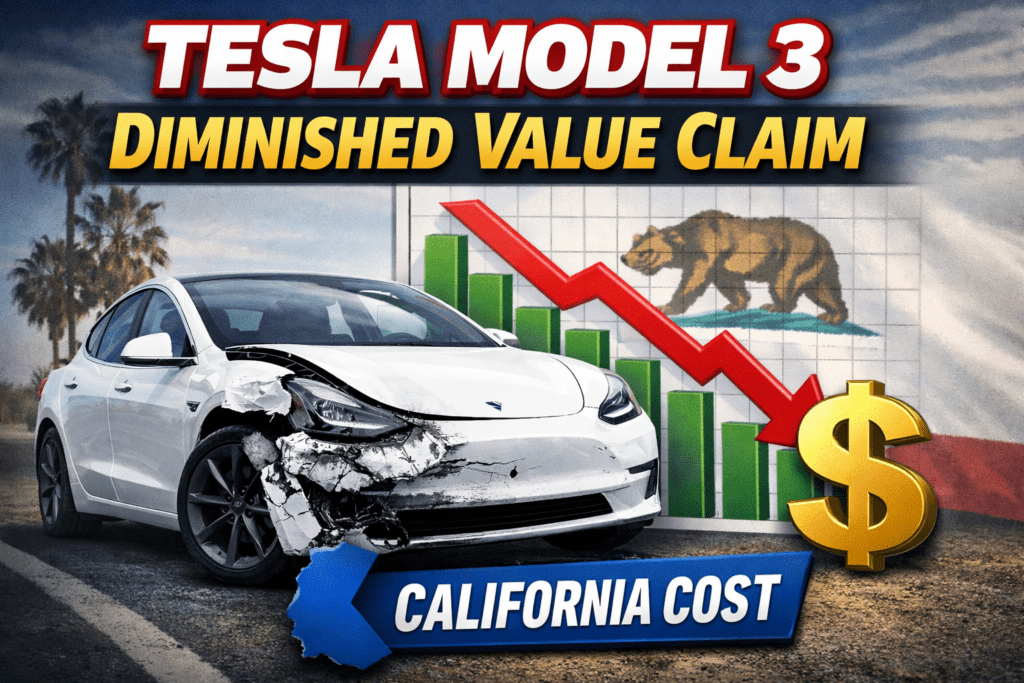
If you’ve been in a no-fault car accident in California, your Tesla Model 3 might have lost significant market value even after being restored to perfect condition by an authorized repair center.
This loss is known as Diminished Value. In California, you have the legal right to recover this “hidden loss” from the at-fault party’s insurance company.
What is a Diminished Value Claim?
Simply put, if a buyer is presented with two identical Model 3s—one with an accident history (even if fully repaired) and one without—the buyer will inevitably demand a steep discount on the accident-hit vehicle. This “psychological devaluation” is the essence of Diminished Value.
The 3 Core Types of Value Loss Every Tesla Owner Must Know
In California claim practice, diminished value is generally categorized into three dimensions:
- Inherent Diminished Value (The Core Loss)
Even if a Tesla Service Center uses 100% OEM parts, the accident record remains permanently on reports like Carfax or AutoCheck. This “accident stigma” leads to a loss in market trust, causing the resale value to plummet regardless of repair quality.
- Repair-Related Diminished Value
Tesla’s aluminum bodies and complex sensor arrays are incredibly precise. Any imperfections, such as paint mismatch (common with Multi-Coat Pearl White), uneven panel gaps, or the use of non-OEM parts, further increase the loss of value.
- Immediate Diminished Value
This refers to the difference in the car’s value immediately before the crash and immediately after the crash, before repairs begin. While claims are usually settled based on inherent value after repairs, this concept establishes the legal foundation for your financial loss.
Who Can File a Claim in California?
Under California law, you can initiate a claim if you meet the following criteria:
- Not At-Fault: The other driver is primarily or entirely responsible (California follows Pure Comparative Negligence; if you are 20% at fault, you can still recover 80% of the diminished value).
- Ownership: You own the vehicle (financed vehicles qualify; for Leased vehicles, the right to claim usually belongs to the lessor, so professional consultation is advised).
- Statute of Limitations: You must file your claim within 3 years of the accident date.
Why is Tesla Model 3 Devaluation Higher Than Gas Cars?
Insurance companies often try to use the outdated “17c Formula” to cap payouts (usually at 10% of the car’s value). This is fundamentally unfair for Teslas because:
- Battery & Structural Integrity: Even minor collisions involving the chassis or battery rails make future buyers wary of battery longevity and structural safety.
- Autopilot & FSD Calibration: The high cost of recalibrating advanced driver-assistance systems creates a “tech-distrust” factor in the used market.
- Software Ecosystem: Repairs at non-authorized shops may prevent the vehicle from passing future Tesla Certified Pre-Owned (CPO) inspections.
Estimated Recovery Ranges:
| Damage Severity | Estimated Diminished Value (Model 3) |
| Minor (Cosmetic/Paint/Bolt-on Parts) | $2,000 – $5,000 |
| Moderate (Suspension/Sensors/Structural) | $5,000 – $10,000 |
| Severe (Airbag Deployment/Battery Frame) | $10,000 – $18,000+ |
How to File a Claim in California
- Complete Repairs: Keep all OEM repair invoices and parts lists.
- Reject the Initial Offer: Insurance adjusters will often ignore diminished value or offer a “nuisance” settlement.
- Get an Independent Appraisal (Crucial): Hire a certified appraiser to produce a report detailing “Pre-Accident Value,” “Post-Repair Value,” and “Comparable Market Data.”
- Submit a Demand Letter: Formalize your claim to the at-fault insurance carrier.
- Negotiate or Litigate: If denied, you can file a complaint with the California Department of Insurance or pursue a case in Small Claims Court.
Note: A professional appraisal report (typically costing $300 – $800) is your strongest weapon. It effectively debunks the insurance company’s oversimplified internal models.
Frequently Asked Questions (FAQ)
Q: What if my car is declared a Total Loss?
A: In a total loss, the insurance company pays the Fair Market Value of the car. Diminished value is generally not applicable in total loss scenarios.
Q: Will this claim raise my own insurance premiums?
A: In California, filing a diminished value claim against the at-fault party’s insurance should not result in a premium hike for you.
Q: How long does the process take?
A: Usually 2-8 weeks once a professional appraisal report is submitted.
Recover Your Asset’s Value Today
Don’t let an accident record steal your Model 3’s equity. As a Tesla owner, you are entitled to be made whole for the loss in market value.
We Provide:
- ✅ FREE Preliminary Devaluation Estimate
- ✅ Professional Certified Tesla Appraisal Reports
- ✅ End-to-End Negotiation & Legal Support